At our monthly London Dressmakers Club meetings we often mention sewing blogs or other sources of sewing inspiration that we like. We all like different ones and haven't all come across the same ones, so it would be lovely to spread the joy and list one source each that other members (and non-members) may enjoy too.
I hope we will do more posts like this one. Let us know in the comments if you read any of the listed blogs - or even better: tell us if you want to write up your favourite in a future sewing blog post (yes please!). We would like lots of people to contribute to this members blog. It is all about the more the merrier! Please share - one paragraph and the link is all that's needed.
Here goes:
I am being greedy and giving more than my fair share of reccomendations, and I could do many more, but here are 3 of them - Barbara.
i) MOOD SEWCIETY
It is the blog for the legendary Mood Fabric store in the USA. They have the most amazing free patterns to download (for women mainly, but also for men and children) but I am not really sure how to subscribe to this from their site. I used to have to keep checking for new blogs every so often but I have accidentally managed to subscribe to it today via Bloglovin.
The link should be here.
ii) STITCH SISTERS
This is a vlog rather than a blog. The lovely Nikki and Rachel run a sewing school in Sodbury, near Bristol, and even though you might not get to their school you can still get loads of advice, reviews, fabric hauls and inspiration from their vlog. They are just as friendly and chatty in the flesh as on the screen- they do come to London sometimes and I have been able to admire the creations they have been wearing IRL. They sew the sort of garments I would make for myself - if I had a bit more flair and colour sense.
The link should be here
iii) STITCHER'S BREW
And this one is a podcast. An hour or more each Friday of bubbly chat from Gabby (Gabberdashery) and Megan (Pigeon Wishes) and their guests of the week who are people whose blogs you may well read or whose independent businesses you buy from or otherwise involved in the sewing world. It is like eavesdropping on a stitcher's tea party and just the thing to listen to while seated at your sewing machine- preferably with a mug of tea and a bit of cake to hand- and hear the behind the scenes stories.
The link should be here
Here is my contribution - Giselle:
I always enjoy reading the Allison C Sewing Gallery blog
She uses quite a few Burda patterns and her garments are often very interesting but entirely wearable. There is one from the July edition of Burda Style that she refers to as #113 Knot Dress. It has a very intriguing round "cut-out" that gets gathered up with a bow. I am fascinated by pattern details like that!
She makes all kinds of garments: dresses, blouses, coats, trousers, you name it. I am very jealous about the fit she achieves!
Catherine's Patterns
I also enjoy reading about all kinds of patterns and garments that Catherine sees at exhibitions, and the many fantastic photos she posts. She writes about some of the many vintage patterns she owns. What I love the most is the amount of details of some patterns: sometimes it is the cut of a garment but it can also be a design element like a collar or vent or a neckline, or some intriguing gathering... there is such a lot of interest there. I am very glad that Catherine writes her blog! She is also one of our members.
I guess you can see a bit of theme here! There are quite a few more that I love reading, I'll save them for the next post like this!
We want to post more like this one. Part II is to follow soon!
Subtitle
. . . . . . A place to contribute, exchange tips and ideas and find further info on the LDC group on Meetup.
Showing posts with label members. Show all posts
Sunday, 6 January 2019
Thursday, 28 May 2015
Member of the month - Beth
How to sew a ball gown in a bedsit without (entirely) losing your mind
I am fairly new to sewing and when I started I shared a large two bedroom flat with one other person.... now I live in a very small "Studio" (really a bedsit) in East London.
This adventure started as most of my sewing projects do… with some beautiful fabric I bought nearly eight months ago. And for the sake of full disclosure I am still working on this project. But there is a photo shoot on the 31st of May and I am hopeful it will be ready. I will post photos of the completed dress.
I experimented with various ways of pleating the fabric, but as it was very stiff it looked more like a kilt than a ball gown. My solution buy a vintage vogue dress pattern and just not sew the top bit, and add half a meter to the bottom. Turns out that this would have some interesting structural implications.
It being an African printed canvas as I had to buy 6 yards of this beautiful gold and turquoise material, with a complex geometric pattern. For £15 how could I go wrong? If you live in London go to Dalston market and look for the store near to the butcher selling cows feet.
Also I am also a very novice sewer and the only things I had managed to complete before starting this project were a pleated skirt and some shoe bags. But fortune and fashion favour the brave, and I foolishly thought that it would only involve sewing longer seams. A lot of unpicking for accidentally sewing the pleats together happened when sewing the skirt.
Having so much beautiful fabric I decided to make myself a ball gown length full skirt. To put this decision into context I live in a tiny bedsit in central London so sewing something this big was always going to be a challenge but little did I know how much of a challenge it was going to be.
Also I am also a very novice sewer and the only things I had managed to complete before starting this project were a pleated skirt and some shoe bags. But fortune and fashion favour the brave, and I foolishly thought that it would only involve sewing longer seams. A lot of unpicking for accidentally sewing the pleats together happened when sewing the skirt.
I experimented with various ways of pleating the fabric, but as it was very stiff it looked more like a kilt than a ball gown. My solution buy a vintage vogue dress pattern and just not sew the top bit, and add half a meter to the bottom. Turns out that this would have some interesting structural implications.
My first challenge was cutting out the fabric. I discovered that the fabric was very narrow compared to others that I have bought. This meant that the gold bits would be hidden in the pleats of the dress if I used my original vertical layout, so I opted for a vertical layout. I also had to cut from salvage edge to salvage edge.
My room is only 4.5m long so I needed to rearrange my furniture so that I would have a clear path to lay out the fabric. This was like playing solo twister!
I then started to place the fabric so that the patterns would match, given the horizontal & vertical patterns in the fabric, choosing a pattern with princess seams, was not the best idea (next time solid colours only!). I thought I did the pattern matching correctly but turns out I matched on the cutting edge rather than the sewing line. GRRRRRRR!!!!!!! After much foul language, tears and ripping out seams I got to a place that I was happy with, the patterns if not the fit.
The pattern was originally a dress and in altering it I forgot to take account of the weight of the fabric. It being very heavy I needed to put some structure in place. I originally tried grosgrain in place of boning on the outer skit, then tried to use it as casing for plastic boning. Neither really worked. I tried boning the inner skirt, but it wasn't strong enough.
In order to provide the support that I needed I had to sew a underskirt and add a wider boning to it. Professor Pincushion has some useful tutorials. But this didn't look that great. I have now opted to sew the boning to the grosgrain then sew the grosgrain to the outer fabric.
And this is where I have got to so far. To do this week:
1) adjust fit of skirt (I have gained weight over the last 8 months)
2) finish sewing in the boning/grosgrain
3) attach Petersham at waist
4) attach underskirt
5) do zipper
6) hem 9m of circle skirt :(
7) Find an occasion to wear this thing!
What I have learned
- Buy a foam gardening kneeler (pound shop ones are good), it will save your knees when pinning and cutting fabric.
- Yes it is worth it to baste your seams.
- If you are going to be walking on your fabric to cut it out wear clean socks.
- Electrical tape is awesome for marking hemlines and holding seams together.
- Write the piece number and direction to the centre front in the seam allowance so that you can remember which piece is which when you come back to your project after a few weeks.
Friday, 24 April 2015
Our Sewalongs
![]() |
| Butterick 4790 |
Every so often we schedule sewalongs as part of the LDC group's events. This is how they work:
Our sewalongs usually start with some members of the London Dressmakers Club deciding that they would like to make either a specific garment or item, or something with a specific theme. Sewalong aren't "meetings" as such. We don't meet up in a physical location for this, this is an opportunity to sew the item at home, at your own pace: a sewalong is just like a knitalong, you do your own thing and then you compare notes.
The scheduled event gives you a chance to exchange tips and comments with the others who have signed up. You can post comments on the Sewalong meetup page, or upload photos in the suitable photo album. If you have a query or get stuck with your project, then ask a question in the comments or bring your work-in-progress along to a monthly meeting to ask the others for advice in person.
Meetup allows us to post meetings that last up to two weeks, but no more. The Sewalongs typically run much longer - we like to put them on for anything from two to three months. It is up to you whether you might like to get started early and get it done, or if you want to space out your sewing a bit over the entire period. Life is busy and it can be a challenge to find sewing time. It is important to be able to sew in whichever way works best for you. The Sewalongs can be great inspiration and motivation to complete a specific item.
Some sewalongs are quite informal: we did put a 'simple item' sewalong on a while ago and dressmakers could make anything they wanted. We set a time of two months and invited comments and photos but didn't suggest any other framework or structure.
Other sewalongs were a bit more structured: we split the two months into several two week slots that we scheduled individually and suggested specific tasks for each part. We will probably keep doing both kinds of sewalongs, some people prefer one to the other.
Our May/June/July sewalong is to make a Summer Wrap Dress - any kind. This came out of several members wanting to make the Walk Away dress (as seen on the Sewing Bee 2015: Butterick 4790 or the vintage edition Butterick 6015. There was even a 'Walk Away Dress, the Mini Version'! Butterick 6204), some of us have the pattern and want to make it up. It is up to you whether you want to make the Walk Away dress or another kind of summer dress, it doesn't strictly have to be a wrap dress, this is more by way of suggestion. Go with whichever pattern and style of dress you feel like!
![]() |
| Butterick 4790 |
![]() |
| Butterick 6015 |
Do you have any question about our sewalongs? Don't be shy asking, just post a comment below or on the relevant sewalong meetup page.
Happy Sewing!
.
Labels:
advice,
challenges,
LDC,
meetings,
members,
online,
planning,
project,
project plans,
sewalong,
sewing
Friday, 17 April 2015
Member of the Month April 2015 Jennifer Taillefer
Hello everyone!
I am really loving being part of this group so far, as none of my
friends are really into sewing, and while they are very kind about listening to
me talk about projects, I can tell they don’t have a clue what I am banging on
about! So it is lovely to read the
posts here, and to have met some of you at an outing.
I have been sewing since I was five years old,
when my mother bought me my first little hand crack machine and showed me how
to make outfits for my dolls. I love to
upcycle items, play with different ways of putting patterns together (is it
called pattern hacking these days?), and to clash fabrics and colours. I am very inspired by the fashions of the
1920’s to the 1960’s. I have a
particular love of very finely finished garments, and I am always trying out
new seam finishes, and ways of making the inside of my pieces as beautiful as
the outside. If you want to know more about me my new website is at www.jennstitches.com . I also really enjoy taking
old garments and remaking them into new ones, especially as I hate to see
fabric wasted. Therefore Make Do and
Mend is right up my street, and that combined with my love of vintage fashion
made me eager to see the exhibition I am writing about today.
Fashion on the Ration: 1940’s Street Style is
currently on at the Imperial War Museum.
As a lover of all things from the first half of the 20th century, I was
eager to see it, and hopefully get some inspiration for my own sewing.
During the Second World War, women showed great
ingenuity in clothing their families despite the rations that were placed first
on ready-made clothing, and then on dressmaking fabrics. By re-using and adapting clothes that were
already in their possession they created new garments, and I would say a very
personal sense of style. I was really
taken with how unique the women looked in the photographs in the exhibition,
much more so than in group photos from earlier decades.
There are a number of homemade garments on
display in the exhibition as well as a series of uniforms for various branches
of the services, although the actual garments are outnumbered by photos of what
was worn. There is however, an excellent
section on Utility clothing.
The Utility scheme was introduced in 1942 as an
attempt to create more equality in the clothing available to those in different
financial strata. When rationing was
first introduced an article of clothing required the same number of coupons
regardless of the quality. Therefore
someone who could afford a high-quality, robust garment would have it last much
longer, thereby freeing up future coupon allocations for other wardrobe
pieces. Those who had to purchase much
cheaper versions would find themselves needing to replace the garment a great
deal sooner. By introducing the Utility
scheme the government was trying to standardise the quality of clothing, and at
the same time save even more fabric for the war effort by limiting the amount
that could be used for any particular kind of garment.
The range of clothing on display in this part of
the exhibition is a testament to how much you can do design-wise with very
little material!
Seeing the exhibition inspired me to have a go
at a vintage pattern I had bought last year.
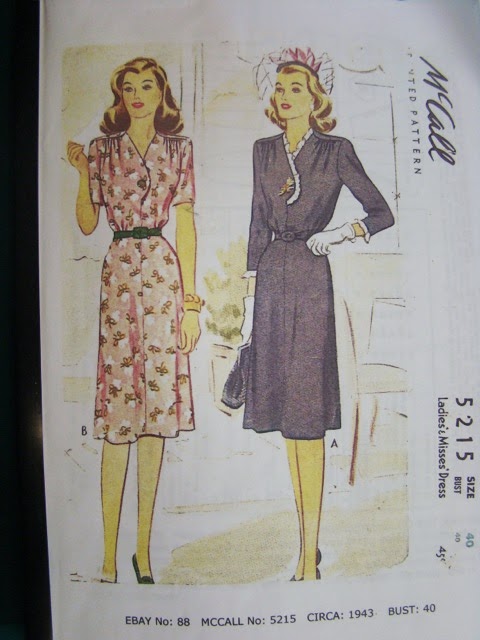
This is a reproduction of a 1943 McCall’s dress pattern, and it uses
surprisingly little fabric for the amount of style detail that is in it.
As you will see from the images, it is a lovely
curved neckline, which is finished with a rather scanty facing - but why waste
material on the inside! I will say that
the neckline was the hardest part of the dress, and I did have to baste it into
place twice before I got it to sit nicely.
This is because the shoulder seam is sitting to the front of the
shoulder and has a curve in it as well.
There are several large dots close together on the pattern at the
shoulder, and it took some time to work out which ones were supposed to match
up! I did burst out laughing at my first
attempt and I wish now I had taken a picture of it on the mannequin!
The fastening on this dress is a placket
fastening. Some of you might remember
seeing the contestants on GBSB Series Two grappling with this on the vintage
blouse they made. Essentially the way it
works is that the seam allowance on each side of the opening is faced with a
small rectangle of fabric, one folding inside the garment and one extending past
the edge. These then overlap and have
hooks and eyes or poppers attached to close the gap when the dress is done up.
The bright red button and the buckle on the belt
were both vintage items I found at my great aunt’s home. She was a seamstress as well, and I love
adding little bits and pieces I found in her stash to my own garments.
The exhibition at the IWM is on until the 31st
of August and is well worth a visit. I
particularly liked the recordings of real people sharing their experiences of
Fashion on the Ration! If you do go and
get inspired to try a vintage make, then do post a picture of it so we can all
admire.
P.S. from Barbara- Do check out Jennifer's web site and all the fantastic things she has made in the photograph Gallery there.
Monday, 23 March 2015
Member of the month
Hi,
My name is Emma Smith, and I confess I'm a fabric hoarder and compulsive sewer!
This is me wearing the Wear anywhere dress by So Sew Easy
My journey started as a child - my mum used to make me and my sister dresses and I had a bag of scraps which I used to hand sew clothes for my Sindy dolls. I progressed to mini hand sewn patchwork using hexagonal blocks and eventually moved on to clothes.
I took needlework o-level (my only "A" grade!), a B-tech in fashion and textiles, finishing with a fashion and textiles degree.
For 8 years after I graduated I worked for various UK manufacturers, designing mainly childrens wear. A job I loved, but the UK retailers priced the UK manufacturers out of the market by using cheap offshore producers and after 3 redundancies I made the decision to change direction I to a more sensible industry.
So that's my potted history.
After I moved into my role in IT services I continued to sew for pleasure and was lucky to live in a flat where I could have a dedicated sewing room. But once I met and moved in with my husband I no longer had that luxury and in the flush of a new relationship my sewing waned.
I decided that in order to meet people in my new home and to give myself a creative outlet I'd try painting, and spent quite a few years expressing my creativity via watercolour and acrylic painting classes - it was a great outlet away from work and a rear stress buster.
It was the need to shorten a curtain that got me back to sewing. I got my machine out and couldn't remember how to use it! I was devastated as sewing had been a big part of my life and what had shaped my early years and career. Well that spurred me on, I not only got the machine under control but determined to change my creativity from painting back to sewing.
That was three years ago and pretty much tied in with series 1 of the GBSB, and since then there is no stopping me!
So on to what you really want to see - the photos!
I make dresses...
This one is the Sew Over It Tea Dress

This is the Bella dress that came free with Love Sewing magazine
And this one from Salme - their buttonless shirt dress

I also make accessories:
this was a self drafted knitting needle case as a gift for a friends birthday
another self drafted bag for my niece

And a cushion for other friends who had their 40th just a few days apart
And things for my nieces and nephew:
I have so many patterns i could never hope to make them all and similarly so much fabric that I don't know what to do with it all. Neither of which stops me adding more to my stash at every opportunity
Hope you enjoyed my story! There's lots to come still as I work my way through my stashes.
My name is Emma Smith, and I confess I'm a fabric hoarder and compulsive sewer!
This is me wearing the Wear anywhere dress by So Sew Easy
My journey started as a child - my mum used to make me and my sister dresses and I had a bag of scraps which I used to hand sew clothes for my Sindy dolls. I progressed to mini hand sewn patchwork using hexagonal blocks and eventually moved on to clothes.
I took needlework o-level (my only "A" grade!), a B-tech in fashion and textiles, finishing with a fashion and textiles degree.
For 8 years after I graduated I worked for various UK manufacturers, designing mainly childrens wear. A job I loved, but the UK retailers priced the UK manufacturers out of the market by using cheap offshore producers and after 3 redundancies I made the decision to change direction I to a more sensible industry.
So that's my potted history.
After I moved into my role in IT services I continued to sew for pleasure and was lucky to live in a flat where I could have a dedicated sewing room. But once I met and moved in with my husband I no longer had that luxury and in the flush of a new relationship my sewing waned.
I decided that in order to meet people in my new home and to give myself a creative outlet I'd try painting, and spent quite a few years expressing my creativity via watercolour and acrylic painting classes - it was a great outlet away from work and a rear stress buster.
It was the need to shorten a curtain that got me back to sewing. I got my machine out and couldn't remember how to use it! I was devastated as sewing had been a big part of my life and what had shaped my early years and career. Well that spurred me on, I not only got the machine under control but determined to change my creativity from painting back to sewing.
That was three years ago and pretty much tied in with series 1 of the GBSB, and since then there is no stopping me!
So on to what you really want to see - the photos!
I make dresses...
This one is the Sew Over It Tea Dress
And this one from Salme - their buttonless shirt dress
I also make accessories:
this was a self drafted knitting needle case as a gift for a friends birthday
another self drafted bag for my niece
And a cushion for other friends who had their 40th just a few days apart
And things for my nieces and nephew:
I have so many patterns i could never hope to make them all and similarly so much fabric that I don't know what to do with it all. Neither of which stops me adding more to my stash at every opportunity
Hope you enjoyed my story! There's lots to come still as I work my way through my stashes.
Monday, 16 February 2015
Member of the Month - February 2015

Our February Member of the Month is Camilla who has recently started on the dressmaking road.
My interest in sewing began when I was small. My Nan was a dressmaker and used to make me
all sorts of things customised to the dreams and whims of a very girly little
girl (The Sound of Music, Barbie, Jem (pictured below) and The Bangles were big
sources of inspiration).
I grew up on the Essex coast and have moved in and around
the London area over the last 15 years or so, and moved to Raynes Park a couple
of months ago. Having moved on from
wanting to be a rock star, I now work full time in London organising global
events for a training company (almost as cool).
I’ve still retained my childhood dream of designing and making my own
clothes so now I’m actually channeling my energy into making it happen, one
garment at a time!
I’m at beginner’s
stage of dressmaking, having started at school with patchwork and appliqué
cushions and then moving on to a long, brown, paneled skirt with matching buttons all the
way down the front. I made a pair of
grey-green, trousers several years ago, with a lot of help from my Mum!! They were wide-leg style with a side zip
(sorry Barbara! - From Barbara - Chacun a son gout, as Prince Orlofsy sings though not in reference to sewing. I hate side zips in trousers but that's just my preference.) and were great because I just couldn’t find any trousers to
fit me on in shops on the High Street. I
managed to lose them in a house move so alas no photo!
My favourite (and most recent) make is a grey skirt I made
last year.
It’s
actually the most challenging project I’ve completed, particularly working out
how to fit a lining inside which felt like a cognitive puzzle :0) The fabric was a light-medium weight crepe I
purchased in John Lewis about 18 months ago and one good thing is that is
doesn’t crease. Whilst I like the
finished skirt, I incorrectly adjusted the length of the skirt and it now sits
too low – on my hips rather than my waist.
Giselle has talked me into having a go at making another one, so I can
learn from my mistakes – an excellent idea which I’m going to buy some fabric
for at our Goldhawk Road meet up in February :0)
Having
very recently joined this group, I felt very welcome and also really enjoyed
listening to what other members had to say about their experiences and current
projects. It made me feel less alone
with my sewing struggles which was just what I needed! I’m really excited to see how everyone is
getting on at our next meet up :0)
My
top purchase last year was the double tracing wheel by Clover
This was recommended in a YouTube clip – Craftovision - https://www.youtube.com/watch?v=APN3LCvehVU This girl is a quirky American sewer and I
found her videos very helpful as my experience, skills and tools were
limited! The double tracing wheel means
you can trace your seam allowance line at the same time as marking the pattern
onto fabric (over carbon, coloured paper).
Saved me a lot of time!
The next item I'm hoping to make is a shift dress in a cotton blend fabric. It's a basic shape with a V-neck and either short or no sleeves (I've not decided yet). My sewing space is the dining room table in my flatshare. It's medium sized and luckily my housemate doesn't use it much so I can use it fairly regularly :0)
Subscribe to:
Posts (Atom)