Subtitle

. . . . . . A place to contribute, exchange tips and ideas and find further info on the LDC group on Meetup.

Showing posts with label exhibition. Show all posts

Sunday, 6 September 2015

Last chance to visit the Riviera Style exhibition at the Fashion & Textile Museum

If you haven't already been, scoot along to this exhibition before it closes on 13 September.  The Museum is closed on Mondays but open until 8 pm on Thursdays.  Their website gives the details of opening hours etc here
 It is not mentioned in the information that Art Fund card holders get in at half price.  Also there is a very nice cafe at the side of the museum should you arrive before opening time or need refreshment.

I loved this exhibition because of all the ideas on shaping fabric to fit the body and decoration that it gave me. The pictures that follow concentrate on women's garment but the display includes men's as well.  Before you get to the main exhibition there is  a room dedicated to the display of shoes by Rayne, a prestigous shoe makers.  Most of these are suited for a lifestyle where you are not tramping the wet streets of the city, in fact you are probably not tramping much at all, but they are beautiful things to look at.  Personally the shoes I longed for are these from the 1930's included in the Riviera Style exhibition.

I loved the way braid is used to trim these early bathing costumes.  I can see this being translated into a stylish shirtdress to wear today.


And these women's swimsuits from 1920's  show further inspiration for adding decoration to a simple garment.

Here is a close-up of one of them.

This boy's costume in knitted fabric shows a good way of stabilising knits when doing buttonholes by backing the placket with a woven fabric.

These two outfits , a playsuit from 1935 and a 1930's beach outfit could be worn today.
 There were not many swimsuits manufactured during the years of the WWII; most people knitted their own and I have a pattern for one in a book published at that time.  However this is one manufactured costume, which has the CC41 utility label, and I love it for the simple shaping, bold pattern and great colour combination.

 Here is a cotton playsuit and matching jacket from the late 1940's that is very much in line with the fashion for day clothes of the time.  I have just made a cotton jacket from a vintage pattern for a day ensemble that is very similar to this jacket here.

By the 1950's there was a lot more demand for leisure clothing, and fabric designs were so imaginative.  This blouse with cuffed kimono sleeves and narrow collar has a  matching pleated skirt and is made in a super print with scenes of produce harvesting.


This rose patterned 1950's playsuit, which also has a matching skirt, shows the variety of methods used to get a skin tight fit.  From the front you can see the princess seaming and centre front seam used to shape the bodice.

And from the back ruching is used to shape the side panels with a centre back zip to allow the tight fitting garment to be taken on and off.
 Ruching (or shirring) was a popular way of creating shape with woven fabrics using elastic tread in the bobbin.  This British cotton swimsuit from 1957 uses this and makes a garment that, elongated, could be copied to create a delightful summer dress for today.


From 1960's  I liked this set that seemed so typical of the period in shape and fabric
  And now the 1970's.  The skirt of the orange costume unbuttons for ease of dressing  and the red one is in then popular "wet-look" fabric.

And, although it is not a garment, I can't resist showing you one of the bathing hats, this one is from the 1960's.

This bikini from 1980's had a caption saying it shows how small swimwear became in that decade.  Difficult as it is to believe now, when you see me, I used to wear ones even smaller than this!


The display of contemporary swimsuits show that designers have an element of nostalgia in their creations.  Even men's swimwear has a print showing a resort in the 1960's and women's suit often have the ruched style of the 1950's.

John Galliano's design has echoes of the late 1940's ensemble in pink, a little fitted jacket and a belted suit.
 And the burkini harks back to the European costumes of the early 1900's.  There really is nothing new under the sun.
 Have you visited an exhibition that you would like to blog about on this iste?  Please contact Giselle through the Meetup site of the London Dressmakers Club for more information on how to do this.

Friday, 17 April 2015

Member of the Month April 2015 Jennifer Taillefer


Hello everyone!  I am really loving being part of this group so far, as none of my friends are really into sewing, and while they are very kind about listening to me talk about projects, I can tell they don’t have a clue what I am banging on about!   So it is lovely to read the posts here, and to have met some of you at an outing.

I have been sewing since I was five years old, when my mother bought me my first little hand crack machine and showed me how to make outfits for my dolls.  I love to upcycle items, play with different ways of putting patterns together (is it called pattern hacking these days?), and to clash fabrics and colours.  I am very inspired by the fashions of the 1920’s to the 1960’s.  I have a particular love of very finely finished garments, and I am always trying out new seam finishes, and ways of making the inside of my pieces as beautiful as the outside.  If you want to know more about me my new website is at www.jennstitches.com .  I also really enjoy taking old garments and remaking them into new ones, especially as I hate to see fabric wasted.   Therefore Make Do and Mend is right up my street, and that combined with my love of vintage fashion made me eager to see the exhibition I am writing about today.

Fashion on the Ration: 1940’s Street Style is currently on at the Imperial War Museum.  As a lover of all things from the first half of the 20th century, I was eager to see it, and hopefully get some inspiration for my own sewing.

During the Second World War, women showed great ingenuity in clothing their families despite the rations that were placed first on ready-made clothing, and then on dressmaking fabrics.  By re-using and adapting clothes that were already in their possession they created new garments, and I would say a very personal sense of style.  I was really taken with how unique the women looked in the photographs in the exhibition, much more so than in group photos from earlier decades.

There are a number of homemade garments on display in the exhibition as well as a series of uniforms for various branches of the services, although the actual garments are outnumbered by photos of what was worn.  There is however, an excellent section on Utility clothing. 

The Utility scheme was introduced in 1942 as an attempt to create more equality in the clothing available to those in different financial strata.  When rationing was first introduced an article of clothing required the same number of coupons regardless of the quality.  Therefore someone who could afford a high-quality, robust garment would have it last much longer, thereby freeing up future coupon allocations for other wardrobe pieces.   Those who had to purchase much cheaper versions would find themselves needing to replace the garment a great deal sooner.  By introducing the Utility scheme the government was trying to standardise the quality of clothing, and at the same time save even more fabric for the war effort by limiting the amount that could be used for any particular kind of garment.

The range of clothing on display in this part of the exhibition is a testament to how much you can do design-wise with very little material!

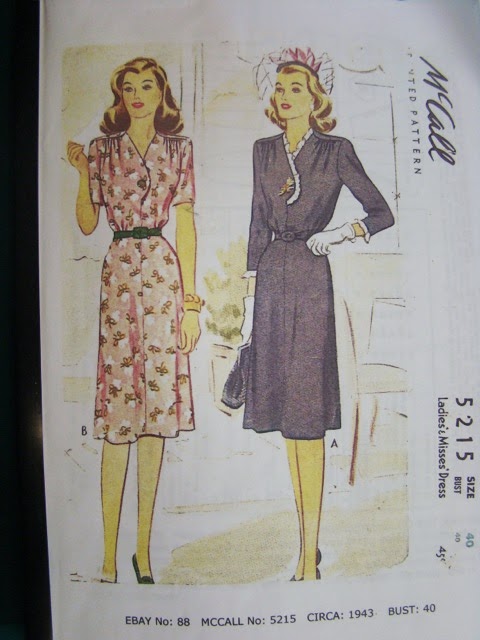
Seeing the exhibition inspired me to have a go at a vintage pattern I had bought last year.  This is a reproduction of a 1943 McCall’s dress pattern, and it uses surprisingly little fabric for the amount of style detail that is in it.


As you will see from the images, it is a lovely curved neckline, which is finished with a rather scanty facing - but why waste material on the inside!  I will say that the neckline was the hardest part of the dress, and I did have to baste it into place twice before I got it to sit nicely.  This is because the shoulder seam is sitting to the front of the shoulder and has a curve in it as well.  There are several large dots close together on the pattern at the shoulder, and it took some time to work out which ones were supposed to match up!  I did burst out laughing at my first attempt and I wish now I had taken a picture of it on the mannequin!


The fastening on this dress is a placket fastening.  Some of you might remember seeing the contestants on GBSB Series Two grappling with this on the vintage blouse they made.  Essentially the way it works is that the seam allowance on each side of the opening is faced with a small rectangle of fabric, one folding inside the garment and one extending past the edge.  These then overlap and have hooks and eyes or poppers attached to close the gap when the dress is done up.


The bright red button and the buckle on the belt were both vintage items I found at my great aunt’s home.  She was a seamstress as well, and I love adding little bits and pieces I found in her stash to my own garments.


The exhibition at the IWM is on until the 31st of August and is well worth a visit.  I particularly liked the recordings of real people sharing their experiences of Fashion on the Ration!  If you do go and get inspired to try a vintage make, then do post a picture of it so we can all admire.
 P.S. from Barbara- Do check out Jennifer's web site and all the fantastic things she has made in the photograph Gallery there.

Wednesday, 25 March 2015

Women Fashion Power Exhibition at the Design Museum.

One of the March meetups of the club was a visit to this exhibition, which runs until 26 April 2015.  If you want a chance to look at garments from the late 1800's to the present day and see what women in prominent positions in various walks of life choose to wear currently then this is for you.
Anyone who gasped at the corset making challenge on the Great British Sewing Bee will be intrigued by the corsets shown at the beginning of the exhibition.


This exquisite example of 1895 has a ventilated mid section with no fabric between the boning there.  It makes one realise that fashionable women of this era felt it necessary to wear corsets all the time, even in the hottest weather.  There were further examples of underwear, showing the evolution up to the Lycra girdle, throughout the exhibition.
In the late 19th century some upper class women had begun to rebel against the high fashion tyranny of layers of heavy, voluminous clothing that restricted their movement and ability to lead an active life as revealed in the advent of the Rational Dress Reform and the Aesthetic Movements.  Their simpler styles did not require the abandonment of beautiful detail as seen in the smocking used to shape this dress of the late 1800's.

However videos show that World War I catapulted the changes ahead as the lack of men at home meant women of all classes undertook types of work never open to them before that were previously the preserve of men and which required them to wear appropriate clothing, even trousers.
The following decade, the 1920's, seem to me to be one of the happiest times for the home dressmaker with garments being of a simple cut and loose fit and sewing machines being available.But, as members who have attended some of our special costume archive visits will know, for evening you could go berserk with beading.  Even shoes followed the trend.
And look at the heels!
Moving on to the 1930's the exhibition showed clothes that we might consider wearing  now.  These, as the tag shows, were Elsa Schiaparelli's own.  Wow, what a colour!
  This is a home made outfit for casual wear at a resort, a jacket and what they called "beach pyjamas" but seemed to me rather like a loose-legged version of the cat suit hack in the new Sewing Bee book "Fashion with Fabric".  I love the fabric pattern of the jacket and the way it is applied as a trim.  The simple jacket shape really allows the fabric to take centre stage
Now patterns became much more easily available and, in the 1930's and 40's, were sometimes linked to clothes seen on Hollywood actresses.  I would really like to sew the Ginger Rogers outfit below.

World War II made a difference to style but home sewers came into their own, particularly in this country with the difficulty in obtaining fabric  meaning that one had to find ingenious ways of saving on fabric and creating new clothes out of old ones.   Below you see a trend for exaggerated shoulders,  as though wearing military epaulettes, making the waist appear smaller although not as small as the drawing below seems to indicate it would be.
  With the end of the war  I had expected that we would see some "New Look" clothing on display but what you get is videos of clothes being modeled.  What I enjoyed next was these great skirts.  Don't they make you want to Rock and Roll?
 I am afraid my interest flagged a bit here because the exhibition continued with fashions going up to the present day that are within my own memory, including these by Pierre Cardin and Andre Courreges.

Thus I tended to concentrate on details that interested me such as the cuffs, ruffles and buttons of this Vivienne Westwood outfit.
And the trim on this power suit by Thierry Mugler
But I was electrified by the Philip Treacy hats.

I enjoyed perusing the fashion choices of contemporary women and decided to ask the members who came what they would chose from that section so here are their choices.

Jennifer chose a Prada cream satin cape from the wardrobe of Dame Zaha Hadid.
Erin went for a black silk dress by Zambesi with a green silk jacket by Merchant Archive from the wardrobe of Anna Jones, CEO of Hearst magazines UK.
Tasha went for a cream wrap dress, there was no label for this one, from the wardrobe of Shami Chakrabarti, Director of the organisation Liberty.  There is a front and back view.

And I eventually decided on a wrap coat from the wardrobe of Jiang Qiong'er, CEO of Shang Xia.    There are  no seams on this coat and it is created from Monologian cashmere by felting.
It is interesting that we all went for simple, fairly minimalist styles  and not items such as Lady Gaga's dress made, chiefly, from black polythene bags.  Who would have thought that rubbish bags could be used to create a gown like this?

There is lots more to see so why not go yourself before it closes next month.

Tuesday, 12 August 2014

Paris- Art, Architecture & Amour OR Fashion, Fabric & Food

Well, which would you go for?  To tell the truth you can do all six.  I was in Paris for a few days recently to visit an old Parisian friend, to catch up with some Canadian relatives while they were traveling in Europe (I love them dearly so there is the Amour) and to enjoy myself generally.
While I was there I went to a current exhibition," Paris 1900" at the Petit Palais, appropriately built for the 1900 Exposition Universelle-(Architecture), in which, according to the publicity "Over 600 works will plunge visitors to the Petit Palais into the atmosphere of Belle Époque Paris. There will be paintings, objets d’art, costumes, posters, photographs, films, furniture, jewellery and sculptures"- (Art).  It evoked a sparkly atmosphere of sophistication, luxury and change- ignoring the less fortunate of the time.  But what you want is the Fashion!
Look at the hours of work that must have been necessary to create this jacket. 


Clothes like these really were only for the rich. Even a day dress had much in the way of pin-tucks, insertions and frills to be sewn by some poor seamstress.


And you needed a maid to get into it as it is fastened down the back with buttons and hooks and eyes.


Even elegant footwear must have been a struggle to get on unaided.


And as for evening wear-  this dress is believed to have been designed by Worth, one of the most famous designers of the time, for a rich American client. 


However this exhibition closes on 17 August 2014.  Luckily you have until 2 November 2014 to get to  the Palais Galleriathe  and the exhibition  on French Couture in the 1950's.  Unfortunately absolutely no photography was allowed at this exhibition but you will see some images on another blog here.  This blog seems to indicate that it is only Christian Dior garments but it includes over 100 items from many different couturiers including Gres, Balenciaga, Cardin, Vionnet, Chanel, Schiaparelli, Piguet and many more.  It included both day and evening wear, swimwear, lingerie plus hats and other accessories.  Well worth a visit and I would have loved to get the hefty hard back catalogue but it was almost 45 Euros.

And I was saving my money for the next item- Fabric.  If you have never been then I can assure you that all you have heard about fabric shopping around Sacre Coeur is true.  And not just fabric but haberdashery of all sorts as well.  If you are going by Metro then the nearest is Anvers and the shops are concentrated in the area between that Metro and the steps leading to Sacre Coeur.  Look out for Rue d'Orsel, Place St Pierre, Rue Seveste, and Rue Charles Nodier.  Some retailers have several outlets so you come across stores with the same name "Au Bonheur des Dames", or  "Au Gentleman des Tissus" for example.  Just wander and rummage.  The most tempting are the "Coupons", lengths of fabric cut into 3 metre lengths and piled high inside and outside the shops.  You can also buy fabric by the metre, it ranges from the very cheap (and rather nasty) to the absolutely exquisite ex-haute couture and everything in between.  Furnishing fabrics are also sold.


Shops are open Monday to Saturday, usually from 9.30 to 19.00 but some do not open until the afternoon on a Monday.  The staff are usually knowledgeable and helpful.  Below is the lovely Sabrina, at one of the branches of "Au Gentleman des Tissus",  who eagerly asked me about fabric shopping in London.  I am about to buy the black and white striped cotton laid on top of the other fabrics near the counter: 3 metres of 148 cm wide for 10 Euros.  I eventually came away from the area with another 2 pieces of 3 metres each, for 5 and 10 Euros, making a grand total of 25 Euros for 9 metres of fabric.
There are several shops devoted exclusively to haberdashery with a fantastic range of colours in items such as zips and lashings of trimmings of all sorts.

Several shops also sell leather


And now for Food as after all that shopping I wanted a quiet and restful spot for a pot of tea so I went to my favourite place for afternoon tea and cake.
  Musee Jacquemart-Andre, 158 boulevard Hausmann- a fabulous mansion house, now a museum filled with works of art collected to decorate this home of a very wealthy 19th century husband and wife.  It is open every day of the year and, although you have to pay to go around the museum, entry to the cafe is free.  The cafe is a work of art itself with a ceiling by Tiepolo and Flemish tapestries based on the story of the Greek warrior, Achilles.


It is very peaceful ( I suspect people do not realise it is there and you can just go in the cafe without going to the museum) and I can imagine myself as a wealthy guest of the previous owners, choosing which type of tea I shall have from the varieties on offer, note that they do other drinks as well but tea has a sort of old-fashioned graciousness that goes better with the decor.  Oh, and the food- really you should go in two's because the cakes are so huge and rich and it is better for one's diet to share one.  However I did manage to consume all of this pile of deliciousness.  It's a massive pistachio macaroon cake filled with pistachio cream and the hugest raspberries I've ever seen.  I'm afraid I'd eaten a fair bit of it before I thought to take a picture But I think there is enough to give you the idea.